Saturday, 1 October 2011

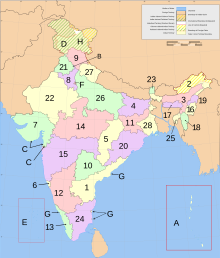
List of states and capital ( India )

States of India and their Capital
No
States
Capital
1
Andhra Pradesh 
Hydrabad 
2
Arunachal Pradesh
Itanagar
3
Assam
Dispur
4
Bihar
Patna
5
Chhattishgarh     
Raipur
6
Goa  
Panji
7
Gujarat     
Gandhinagar
8
Haryana
Chandigarh
9
Himachal Pradesh    
Shimla
10
J&K
Jammu & Shrinagar
11
Jarkhand 
Ranchi
12
Katnataka 
Bangalru
13
Kerela
Thiruvananthapuram
14
Madhya
Bhopal
15
Maharashtra
Mumbai
16
Manipur
Imphal
17
Meghalaya
Shilong
18
Mizoram
Aizwal
19
Nagaland
Kohima
20
Orissa
Bhubenswar
21
Punjab
Chandigarh
22
Rajesthan
Jaipur
23
Sikkim
Gangtok
24
Tamil Nadu
Chhenai
25
Tripura
Agratala
26
Uttar Pradesh
Lakhnow
27
Uttrakhand
Dehradun
28
Pachim Benga
kolkata
29
New Delhi
Delhi


Union Territories: Div & Daman, Dadara & Nagar Haveli, Andaman & Nicobar, Puducherry,                           
                             Chabdigarh, Delhi 

Friday, 23 September 2011

Markets lose faith in the Fed

It’s like the children’s rhyme. Ben Bernanke sneezed and they all fell down. By the end of the day, the Indian currency’s 2.5% depreciation against the dollar was worsted only by that of the Korean won in the Asia-Pacific region. 
            

Similarly, only Jakarta and Hong Kong did worse than the Indian equity markets, which fell 4%. The weakness in the equity and forex markets fed off each other. 


Thursday’s slide was a bit extreme as investors ran towards the dollar after the US Federal Reserve chairman talked about the “significant downside risks to economic outlook”. As one has seen before, and perhaps paradoxically, that prompts investors to see dollar as a safe haven. This, plus an arbitrage opportunity with offshore non-deliverable forward markets, has squeezed the local currency down.


It could get worse as banks start deleveraging and liquidity problems are exacerbated around the world. We are already seeing some evidence. Banks and investors are moving away from riskier assets and some Asian markets have fallen as deeply as 22% since the start of 2011. The benchmark Sensex index of BSE is not far behind at 20%. Net foreign portfolio investment in India totals a measly $622 million (around Rs. 3,050 crore today) so far this year. 


Graphic by Naveen Kumar Saini/Mint
As a result, the rupee has been depreciating for quite some time now. Year-to-date, the local currency slid by 9.83%, the worst among Asia-Pacific currencies. Another reason for the decline is the widening, and structural, current account deficit, which clocked in at 3.4% of the economic output last quarter.


 While exports have been rising at record levels in recent months, these may not be sustainable in the future. At the same time, India continues to be a net oil importer, and the import bill is unlikely to come down by the same extent. 


 These factors will continue to put pressure on the local currency in the near term. The central bank’s ability to intervene in the market is also limited by local liquidity conditions; banks are still net borrowers under the liquidity adjustment facility and the whole situation is exacerbated by the government’s cash deficit position. 


 A corollary to this is the concomitant decline in equities. A Macquarie Capital Securities India (Pvt.) Ltd study shows Indian stocks and currency are highly correlated. Simply put, stocks gain when the rupee is appreciating and vice-versa.


 Not that equities want more reasons to tank. The European Systemic Risk Board has issued a warning similar to the US about increasing risks in the financial system—an ominous reminder of the Lehman collapse.


 Flash purchasing managers’ indices show the manufacturing sector contracted in China this month. Both manufacturing and services contracted in the euro zone, the first time in two years.  


Perhaps more importantly, markets focused on the negative aspect of the Fed Open Markets Committee statement, ignoring its larger-than-expected purchase programme of long-term bonds that is supposed to stimulate the US economy.


 The bad news is the markets seem to be rapidly losing their trust in policymakers.


Sources: LIVE MINT

Sunday, 18 September 2011

After the Telecom Price Wars, the Model Debate

Telecome Price Wars
India’s telecom sector analysts have been speculating for some time on whether tariffs in the country could actually drop to nearly zero. It may sound absurd; nobody is in this business for charity. But the rates are so low that further cuts could make the cost of the paperwork for billing higher than the average bill. At their lowest, tariffs in India reached seven cents a minute. For some limited plans, it was even lower. The idea was to charge subscribers a higher rate for data transfer and offer voice calls almost as a freebie.
But the plan hasn’t quite worked. First of all, data transfer has been slow to take off. Secondly, the earlier price cutting was forced on the industry by increased competition. But some newcomers have retreated because of the highly publicized telecom scams in the country. For the established players, it is no longer necessary to reduce tariffs to protect their turf.
What has happened instead is that the service providers are hiking rates. For example, Tata DoCoMo — the Tata Group’s joint venture with NTT DoCoMo of Japan — started the price wars in the first place. Now the company has also taken the initiative in raising tariffs. In June, Tata DoCoMo hiked its rates on certain plans. But it was only when Bharti Airtel, the company with the largest subscriber base, increased its tariffs in the last week of July by 20% in six major regions that others sat up and took notice. Vodafone and Idea have followed suit.
But even as the service providers are trying to get their financial houses in order, the Telecom Regulatory Authority of India (TRAI) has asked them to offer reasons for hiking rates. The TRAI is investigating whether there is a cartel. Meanwhile, data from the Cellular Operators Association of India shows that the average revenue per user (ARPU) for the four top companies — Bharti Airtel, Vodafone, Idea and Aircel — has stabilized. ARPU fell only 0.83% in April to June as compared to the first quarter of 2011. In the first three months of the year, the fall was 3.4% over the previous quarter.
“The tariff hike by industry signals a reversal of unsustainably low tariffs in the past three years of hyper-competition,” noted a report by equity research house Enam Securities. “The [telecommunications companies] are finally seeing pricing rationale.”
The Indian tariff question has ramifications far beyond the country. Indian telecom companies are expanding globally, particularly to Africa where Bharti Airtel took over the Zain network for $10.7 billion in early 2010. Bharti has exported the Indian tariff model of fully priced handsets and low call rates there. On the other hand, telecom service providers in the West have subsidized handsets with much higher tariffs and lock-in periods.
Indian telecom companies have managed to keep costs under control by outsourcing practically everything from management of IT functions to networks and call center operations. They have also been sharing passive infrastructure like telecom towers and generators. More recently, Vodafone, Bharti and Idea have agreed to share 3G networks.
Can this model be imported to the developed countries? The answer to that question has significant implications because the market in the West is stagnant when compared to the developing world. The growth is in India and China, where the subscription numbers are spurring handset manufacturing and technology development. This is one area where the Indian model could take on the world.
Sunil Mani, planning commission chair in development economics at the Center for Development Studies in Trivandrum in South India, has just completed a paper on the mobile communications industry in India. “The Indian model is more feasible because low tariffs ensure larger access,” he told India Knowledge@Wharton. And handset prices are coming down, too. “Of course, the success of this model depends on the nature and extent of competition between service providers,” he continues. “The role of public policy should be to ensure continued competition while making it viable for the service provider.”
He also points to problems created by the Western model. “In the U.S., the low handset price is recouped through long-term subscribers,” he says. “Despite mobile number portability, these long-term contacts actually stifle effective competition between service providers.”
Source : Knowledgetoday

Friday, 16 September 2011

NEVER THINK YOU ARE ALONE BY PUNIT BHAT

1. There are atleast 3 ppl in d world at any point in ur life who think their life is meaningless without you. 2. Every night, there are atleast 2 ppl who think of you before going to sleep. 3. At any point in ur life, u’re liked by someone you don’t even know exists and that person wishes to have u as a friend. 4. Your name is pronounced a minimum of 10 times a day by people far away from you. 5. At any point in your lifetime, you are hated by someone because they can’t be like you… So never think you are alone… -By PUNIT BHAT.

Tuesday, 13 September 2011

XBRL INDIA


XBRL (eXtensible Business Reporting Language) is a language for electronic communication of business and financial data which is revolutionising business reporting around the world. It offers major benefits to all those who have to create, transmit, use or analyse such information. XBRL has been developed by XBRL International, a not-for-profit consortium of over 450 companies and organisations which is promoting its worldwide use. 
XBRL India is the Indian Jurisdiction of XBRL International. Its main objective is to promote and encourage the adoption of XBRL in India as the standard for electronic business reporting in India. Members of XBRL India include regulators, stock exchanges, software companies and others.
XBRL India has developed draft General Purpose Financial Reporting XBRL taxonomy for Commercial and Industrial Companies. It is currently developing XBRL Taxonomy for the banking sector.  

For More Details Visit http://www.xbrl.org/in/

Sunday, 11 September 2011

10 Years After 9/11: A Lesson should be Learnt By Indian goverment

10 years after 9/11


11-09-2001, this day will never be forgot by america as well as whole day. On that day twin towers, which were tallest building in the world, were attacked by terrorists and around six thousand people died. The america, strongest country in the world, who possess so much of nuclear that the whole world can be demolished for 300 times, was also shaken. Mr. Bush, who was president of america at that time, was also hidden in the safe place. But from that day and till today no terrorists attack has taken place in america. The master mind of this attack was also killed a few months ago. After this terrorist attack only slogan has followed by america is 'Never compromise with the nation's security'. Unlike the America, India is far away. In india average two terrorist attack has taken place in a year, still indian ministers gave unreasonable excuses all the time rather to find out permanent solution like america. But indian ministers have more interest in vote bank rather than nation's security. Terrorists also feels more security than any other country. Here, Terrorists, who were alleged the parliament attack, mumbai attack and many more, were served chikan-biryani.
The only way to solve this problem is to step out from our close doors and show courage to this handicap government and government should also not forget this statement ' A Common man has Guts'...!